Skip to content

AI Gateway for LLM, MCP and A2A traffic

An AI gateway is the one path every model, tool and agent call takes out of your organization. Skyfix runs that path as a single pipeline: identity, policy, inline AI Firewall, budget, routing and evidence, in the same order for a chat completion, an MCP tool call or an A2A task.

  • Industry-standard model APIs
  • Native MCP and A2A
  • Garuda task router

One gateway in the console

See why Garuda chose the model

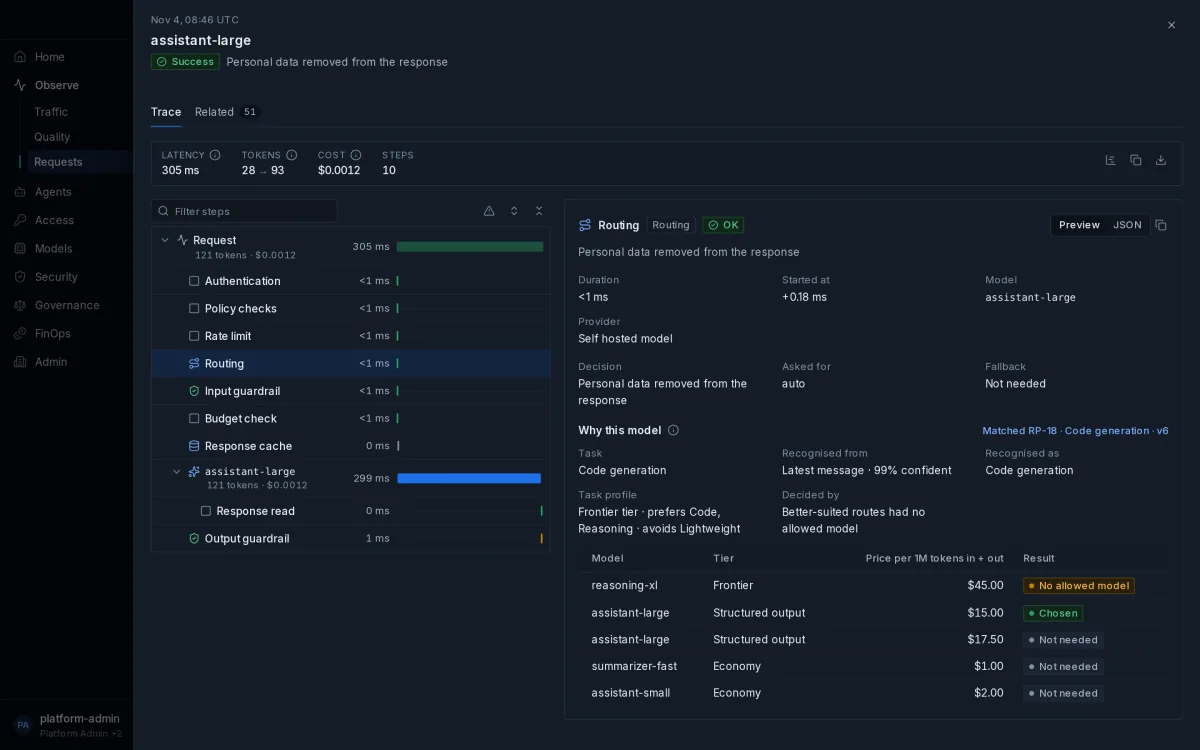
The trace of one request shows the task Garuda recognised, the rule it matched, every route it ranked with its price, and why the top one was ruled out.

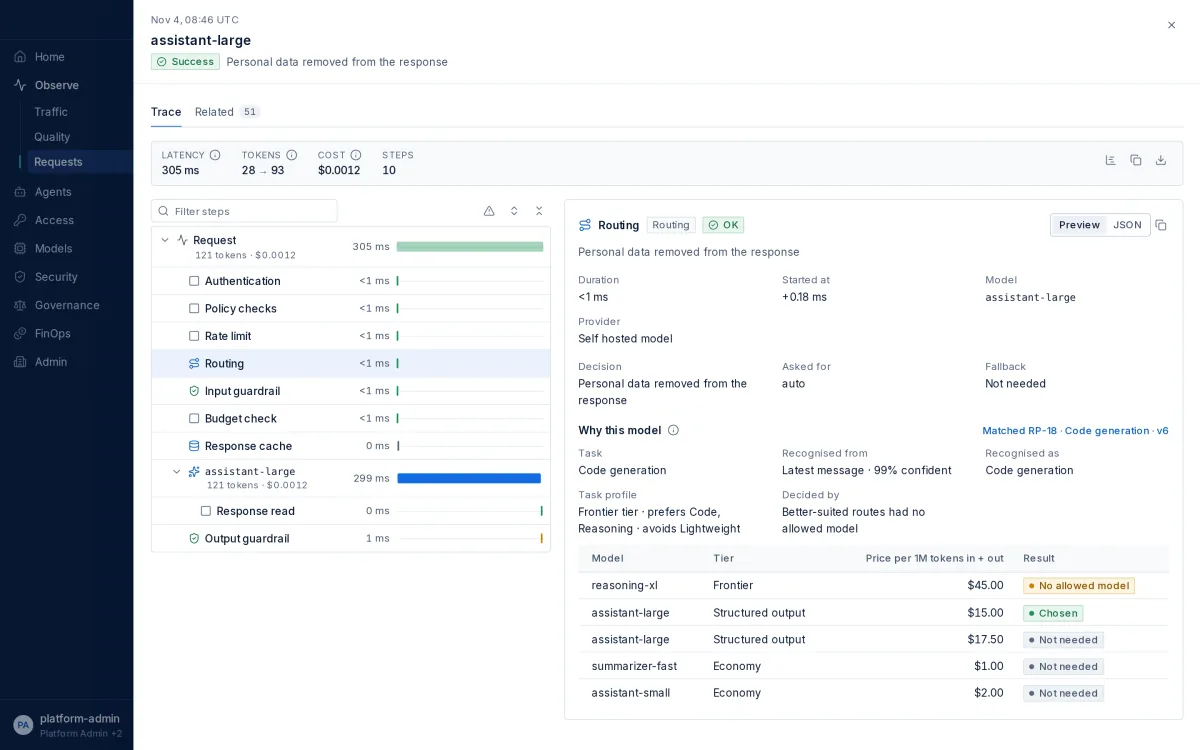
The routing step of a request trace in the Skyfix console: the recognised task and its confidence, the matched task profile, and the ranked routes with one ruled out and one chosen.The routing step of a request trace in the Skyfix console: the recognised task and its confidence, the matched task profile, and the ranked routes with one ruled out and one chosen.
  1. Garuda read the latest message and recognised code generation with 99% confidence, above the rule's 85% threshold.

  2. The matched rule's profile ranked every allowed route on tier and tags and on price; the decision note says the better-suited routes had no allowed model.

  3. reasoning-xl, the only Frontier route, ranked first but was ruled out: this caller's API key is not allowed to use it.

  4. With Frontier ruled out by the key, the next route was a Structured output model. Two providers offer assistant-large; the cheaper one served the request, with no fallback.

One control plane

Where this sits in the request path

Hard gates run before any preference. The router only chooses among what policy already allows, and the same six stages apply to every protocol.

  1. Identity

  2. Policy

  3. AI Firewall

  4. Budget

  5. Route

  6. Evidence

01

One pipeline for every call

  • Six stages, one order
  • Signed bundles

Most organizations end up with one proxy for model traffic, a second for tool servers and nothing at all in front of agents that call other agents. Each one sees a different slice of the same request, with its own keys, its own logs and its own idea of policy. Skyfix replaces those with one gateway that treats a chat completion, an MCP tool call, an A2A task, a skill step and a batch line as the same kind of thing: a governed request.

Every request is authenticated against a scoped key or workload identity, checked against a signed policy bundle the gateway verified locally, inspected inline by the AI Firewall, priced against its budget, routed, and recorded in the decision ledger. Hard gates such as regions, provider allow and deny lists, budgets and guardrails run before any preference, and a request that fails a gate never reaches a provider.

  • Fail closed: if evidence cannot be written in an evidence-required workspace, the request is refused rather than served unrecorded.
  • No control-plane hop at request time: gateways evaluate the bundle they already hold, so a control-plane outage does not stop traffic.
  • One trace ID follows the request through every stage and into your collectors.
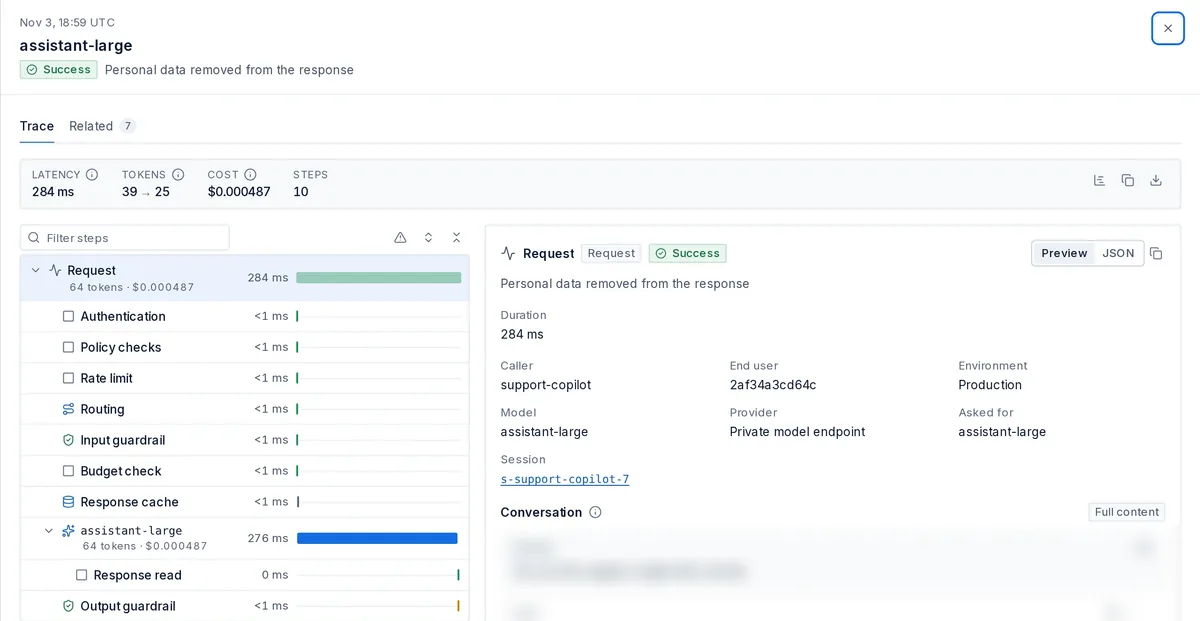
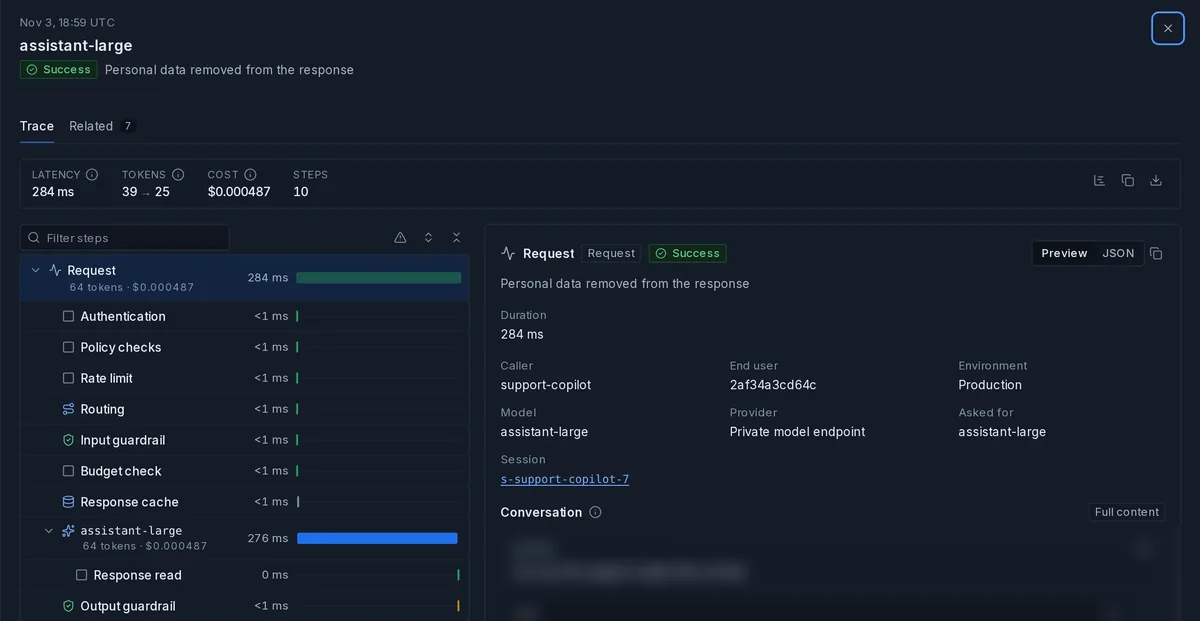
A request trace in the Skyfix console: latency, tokens, cost and step count, a timing waterfall with authentication, policy checks, rate limit, routing, input guardrail, budget check, response cache, the model call, response read and output guardrail, next to the request details (caller, end user, environment, model, provider, session), the status line Personal data removed from the response, and the system and user messages of the conversation.A request trace in the Skyfix console: latency, tokens, cost and step count, a timing waterfall with authentication, policy checks, rate limit, routing, input guardrail, budget check, response cache, the model call, response read and output guardrail, next to the request details (caller, end user, environment, model, provider, session), the status line Personal data removed from the response, and the system and user messages of the conversation.
One request, traced. One request traced through authentication, policy, routing, guardrails, budget and the model call; an MCP tool call or an A2A task takes the same path.Open full size

02

LLM gateway

  • Streaming
  • Batches
  • Prompt registry

Applications keep the client they already have and change the base URL. The gateway serves an industry-standard chat-completions API and other widely used model API formats, plus embeddings, rerank, moderation, image, audio and realtime endpoints, with server-sent events for streaming. Model aliases are the contract: an application asks for a capability name, and platform teams decide which provider and model back it.

Batches run through the same path. Each line of a batch is inspected, routed and priced like a live request, groups of lines are recorded as sent before dispatch so a restart never sends a line twice, and a batch is visible only to the key that created it. A prompt registry lets the gateway render a named, versioned prompt before inspection, so a template change is reviewed once and the AI Firewall still sees the rendered request.

03

Providers, private models and failover

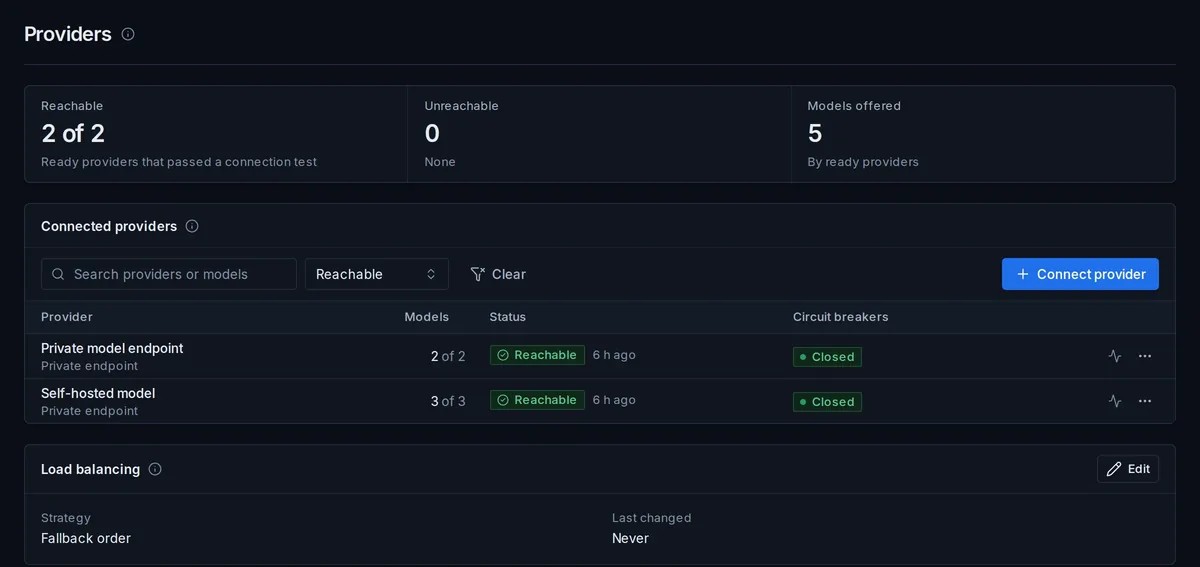
Public model providers, bring-your-own-key accounts, cloud-hosted model services and private or self-hosted endpoints in your network are configured once and addressed through aliases. Each provider is connected over HTTPS with a connection test, health checks and a circuit breaker; a load-balancing strategy such as fallback order decides what happens when the preferred provider is unavailable.

Failover never escapes policy. A fallback provider must satisfy the same region, data-residency and allowlist rules as the primary, and the ledger records which providers were skipped and why. A private model in your own cluster is a first-class provider: it gets the same alias, the same inspection and the same evidence as any public endpoint.

  • Bring-your-own-key credentials are held in your secrets store and never shown in the console.
  • Circuit breakers open on repeated failures and close again after a successful probe.
  • Model catalog entries carry pricing from a maintained catalog, so FinOps sees the cost of every route.
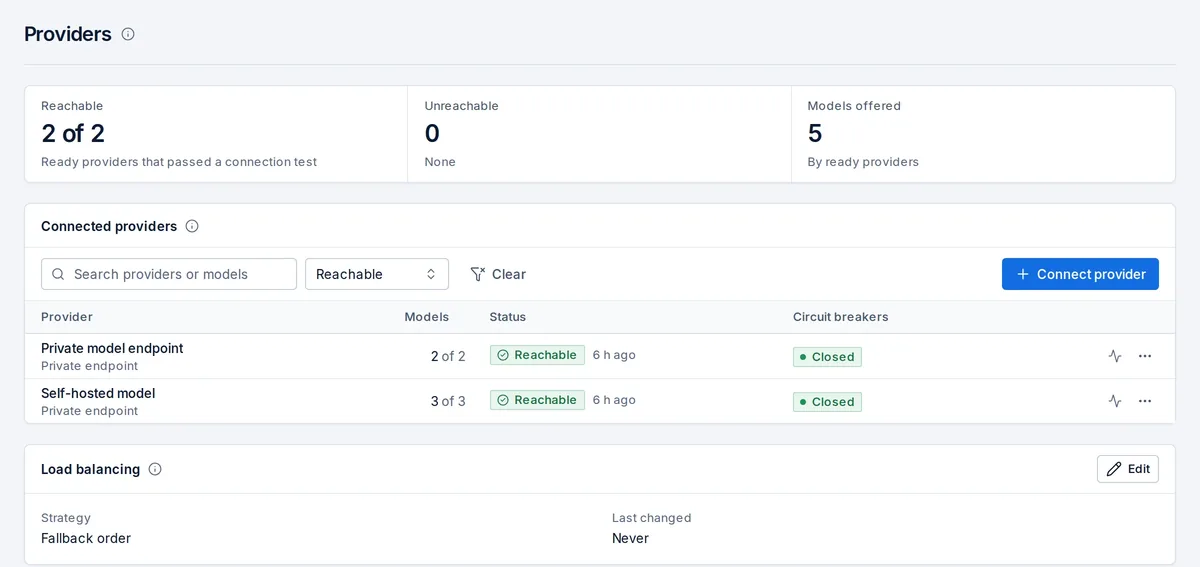
The Models › Providers page of the Skyfix console: two reachable model endpoints offering five models in total, each with a passed connection test and a closed circuit breaker, and a load-balancing card set to fallback order.The Models › Providers page of the Skyfix console: two reachable model endpoints offering five models in total, each with a passed connection test and a closed circuit breaker, and a load-balancing card set to fallback order.
Private and self-hosted model endpoints. Private and self-hosted model endpoints with connection tests, circuit breakers and a fallback order.Open full size

04

MCP and A2A in the same gateway

  • MCP
  • A2A

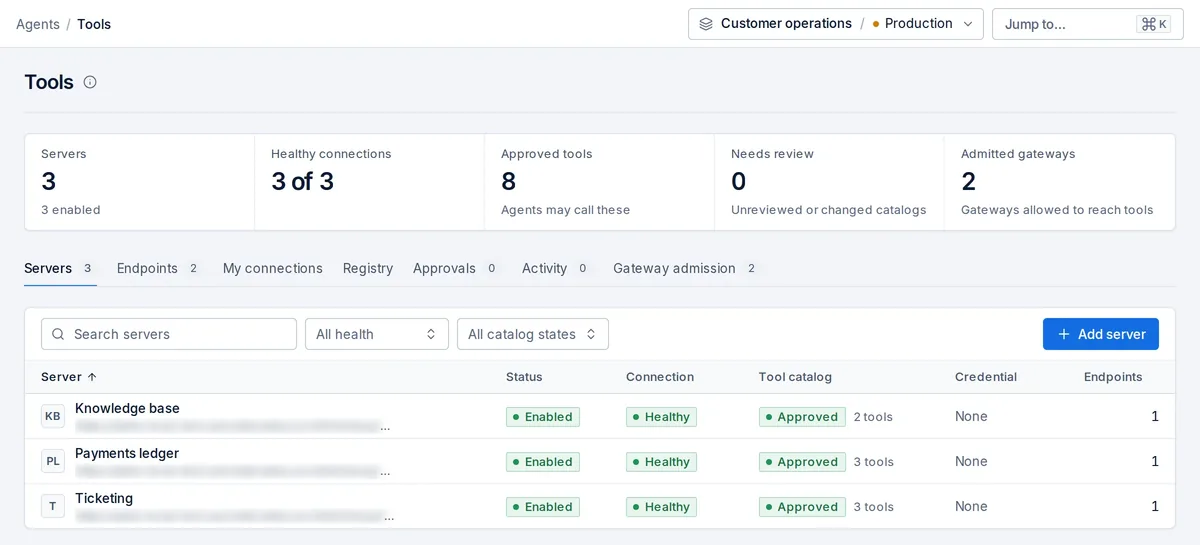
Tools and agents are where most AI risk now lives, and they get the same six stages. The MCP Gateway keeps a registry of tool servers whose catalogs are reviewed and approved, applies per-tool approvals and argument policies, limits calls, and authorizes clients with OAuth 2.1. The A2A Gateway publishes a signed Agent Card for your inbound agent, accepts tasks from allowlisted partners within their scope and rate limit, and federates outbound tasks to external agents.

A tool call or an agent task passes the AI Firewall on its arguments and results, draws from the same budgets as model calls and lands in the same hash-chained ledger. Both implementations are tested against the official conformance suites.

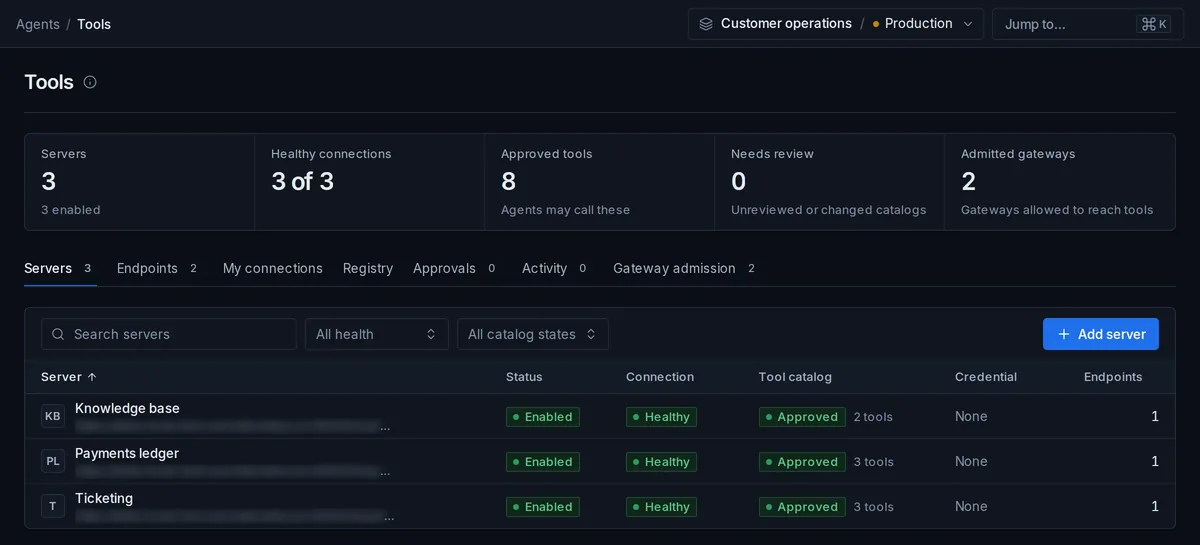
The Agents › Tools page of the Skyfix console: three MCP servers, each enabled and healthy, with approved tool catalogs, the number of tools, credentials and endpoints, under counters for servers, healthy connections, approved tools, catalogs needing review and admitted gateways.The Agents › Tools page of the Skyfix console: three MCP servers, each enabled and healthy, with approved tool catalogs, the number of tools, credentials and endpoints, under counters for servers, healthy connections, approved tools, catalogs needing review and admitted gateways.
Governed MCP tool servers. MCP servers with approved tool catalogs and the gateways allowed to reach them.Open full size

05

Routing inside policy

When an application asks for 'auto', Garuda, the task router, classifies the request and ranks the models that are still eligible after every gate has run. It can prefer a lower-cost model for a classification task and a stronger one for long-form reasoning, but it cannot pick a model that policy denies, a region that is not allowed or a provider whose budget is spent. Router heads are signed and verified like any other artifact; when none is present the gateway falls back to baseline routing. Every decision records the route reason, the models skipped and the fallback reason.

06

Limits, caching and batches

  • Rate-limit headers
  • Caches

Rate limits apply per key and per team on requests, tokens and concurrency, enforced or measure-only, with standard rate-limit headers in every response. Semantic and response caches are administered per installation, so a cached answer is served only where policy allows and is recorded as a cache hit in the ledger. Batches share the same limits and drain behavior: when a gateway is draining or a limit is hit, a line goes back to pending until the retry window passes.

07

Agent Skills and durable workflows

Versioned, approved Agent Skills with progressive disclosure let teams package what an agent may do; every skill step runs as a fully governed request. Durable workflows add checkpoints, retries, compensation, agent memory, human approval steps, environment promotion with dependency checks and signed webhook triggers, so a long-running agent process can be paused, resumed and audited like any other change.

FAQ

Questions this page answers

What is an AI gateway?

An AI gateway is a single, governed path between your applications and the models, tools and agents they call. It authenticates the caller, applies policy and inspection, enforces budgets, routes the request and records what happened. Skyfix runs that path as one pipeline for LLM, MCP and A2A traffic.

What is the difference between an LLM gateway and an AI gateway?

An LLM gateway only sees model calls. An AI gateway also governs the tool calls agents make over MCP and the tasks agents exchange over A2A, with the same identity, policy, firewall, budget and evidence stages. In Skyfix the LLM gateway is one part of the AI gateway.

Can applications keep their existing chat-completions client?

Yes. The gateway serves an industry-standard chat-completions API and other widely used model API formats behind one base URL, so most applications change the endpoint and the model name to an alias and keep the rest.

Can I connect private and self-hosted models?

Yes. Private endpoints in your network and self-hosted models are connected like any provider, with a connection test, health checks, a circuit breaker and an alias, and they pass the same policy, inspection and evidence as public providers.

How does failover work when a provider is unavailable?

A load-balancing strategy such as fallback order selects the next eligible provider. The fallback must satisfy the same policy as the primary, the circuit breaker on the failed provider opens until a probe succeeds, and the ledger records the providers skipped and the reason.

Next step

Bring your AI under one sovereign control plane.

Deployed in your Kubernetes, under your keys.