Skip to content
Company

Security and trust

Skyfix is an enterprise edition installed in your own Kubernetes cluster. Request content, evidence, audit records and every signing key stay in storage you operate; egress and telemetry are opt-in; releases are verified offline before they are applied. This page says what the platform does and where its documentation backs that up.

Trust facts

  • Runs in your cluster
  • Your keys, your root
  • Egress opt-in
  • TLS everywhere
  • Signed releases, verified offline
  • Framework evidence, not certification

01 · Deployment

Deployment model

  • No call-home
  • Air-gap path

Skyfix installs with one Helm chart into a Kubernetes cluster you operate. The control plane, the enterprise console and the gateways run as workloads in that cluster; request data, evidence and audit records live in a PostgreSQL you run; the cache and the secrets store are external and yours. There is no hosted control plane and no call-home: nothing needs an account with us, a license server or a vendor endpoint to start, serve traffic or upgrade.

Ingress and egress network policies are default-deny for private ranges, so private destinations are allowlisted, and public egress can be restricted to approved addresses. For restricted networks the release channel can be left unset and upgrades, detection packs and router heads arrive as signed manifests you verify offline.
02 · Data

Data handling

  • Capture off by default
  • Retention per workspace

Request content, evidence and audit records stay in your storage. Prompt and response capture is off by default; when a workspace turns it on, capture runs with redaction and a per-workspace retention period. Every link outside development uses TLS, and object storage uses server-side encryption.

This page is about customer installations. The website and demo requests are a separate matter, described in the privacy notice.

03 · Keys

Key custody

Every signing purpose, from policy bundles and gateway directives to evidence checkpoints, detection packs and router heads, is a key under one installation root held in your secrets store. Vendor-signed artifacts such as detection packs and router heads are verified, then re-signed under your root before use. No key is built into the images, and a continuous-integration lint rejects any key material in the source tree.

  • One root, one key per signing purpose, all created and held in your secrets store.
  • A signed export verifies offline from your installation's root fingerprint and nothing else.
  • Backups are encrypted under keys from the same secrets store.

04 · Identity

Identity and access

  • Step-up on every route
  • Workload identity

People sign in with OIDC or SAML, are provisioned with SCIM, and can be required to use MFA. Every console route is classified for step-up re-authentication; an unclassified route requires it by default, and high-risk operations such as publishing policy, exporting audit records or changing production ask again. Session lifetime, idle timeout and password policy are enforced server-side. Workloads use scoped API keys, client certificates and SPIFFE-bound gateway enrollment with mTLS.

05 · Releases

Releases and supply chain

  • Expand-only migrations
  • Advisories in CI

Each release has a signed manifest that the installation verifies offline before anything is applied. Upgrades run in place with a Helm upgrade to a bumped version; minor releases use expand-only database migrations, so images can roll back to the previous minor without a restore.

Dependency advisories are audited across every lockfile in continuous integration (Rust, Node and Python audit tools), and a source SBOM is retained per security checkpoint. Signed container images and build provenance are not claimed here.

06 · Posture

Posture and frameworks

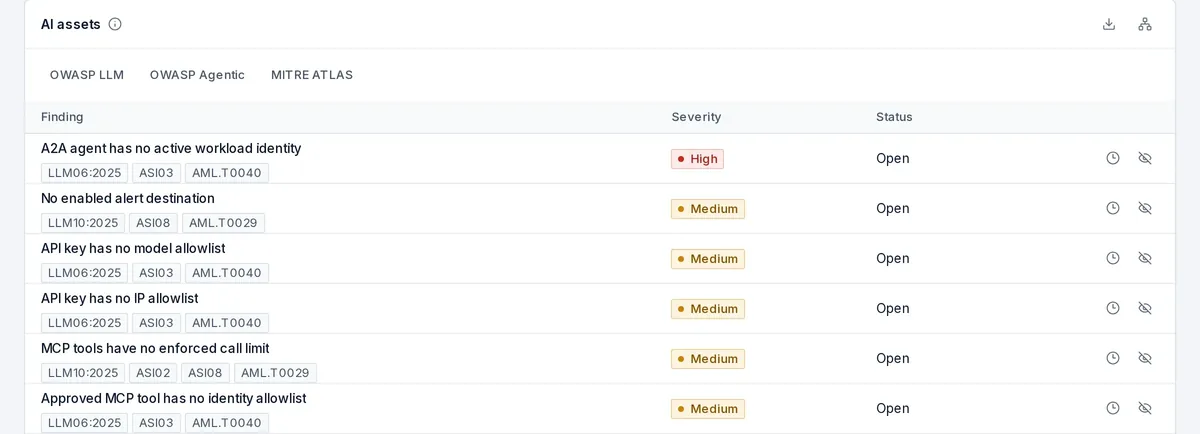
The security posture page lists findings for every AI asset: keys without allowlists, tools without call limits, agents without workload identity. Findings carry OWASP LLM Top 10, OWASP Agentic and MITRE ATLAS tags as risk associations, not framework certification. Framework assessments link controls to recorded evidence for the frameworks you select.

Framework assessments support evidence for frameworks such as the NIST AI RMF, ISO/IEC 42001 and the EU AI Act. They are not certifications, attestations or compliance scores.

The AI assets card of the Security › Posture page of the Skyfix console: findings such as an A2A agent without an active workload identity, no enabled alert destination or an API key without a model allowlist, each with OWASP LLM, OWASP Agentic and MITRE ATLAS tags, a severity and a status.The AI assets card of the Security › Posture page of the Skyfix console: findings such as an A2A agent without an active workload identity, no enabled alert destination or an API key without a model allowlist, each with OWASP LLM, OWASP Agentic and MITRE ATLAS tags, a severity and a status.
Security posture. Security › Posture: AI asset findings with OWASP LLM, OWASP Agentic and MITRE ATLAS tags as risk associations, each with a severity and a status.Open full size

07 · Contact

Security questions

  • Questionnaires
  • Documentation

Questions about the platform, its deployment model or its documentation can be sent to [email protected]. Procurement and security questionnaires are answered from the platform documentation as part of an engagement.

Open standards

Open standards

Supported by name. No proprietary protocol required.

FAQ

Questions this page answers

Does any request or key depend on Arka AI Labs?

No. Gateways authorize each request against a signed policy bundle they verify locally, evidence is written to your own database, telemetry goes only to collectors you configure, and every signing key lives in your secrets store under one installation root.

What leaves the cluster?

Only what you configure: calls to model providers and tool servers you approve over HTTPS with your credentials, OTLP export to your collectors when turned on, and SIEM forwarding over TLS syslog or HTTPS when turned on. Nothing is sent to us.

Is Skyfix certified against a security or AI framework?

No. Posture findings carry OWASP and MITRE ATLAS tags as risk associations, and framework assessments link controls to recorded evidence. They are not certifications, attestations or compliance scores.

How are releases verified?

Each release ships a signed manifest. The installation verifies it strictly, offline, before the Helm upgrade to the bumped version runs in place. Dependency advisories are audited across every lockfile in CI and a source SBOM is retained per checkpoint.

Next step

Bring your AI under one sovereign control plane.

Deployed in your Kubernetes, under your keys.