Skip to content
AI Gateway guide

A2A gateway for agent-to-agent traffic

Agents increasingly call other agents, across teams and across partners. An A2A gateway gives that traffic the same front door as model calls: a signed Agent Card for the agent you expose, partner scopes and rate limits for inbound tasks, and policy, inspection, budgets and evidence for every task in and out.

  • Signed Agent Card
  • Partner scopes and limits
  • Three bindings
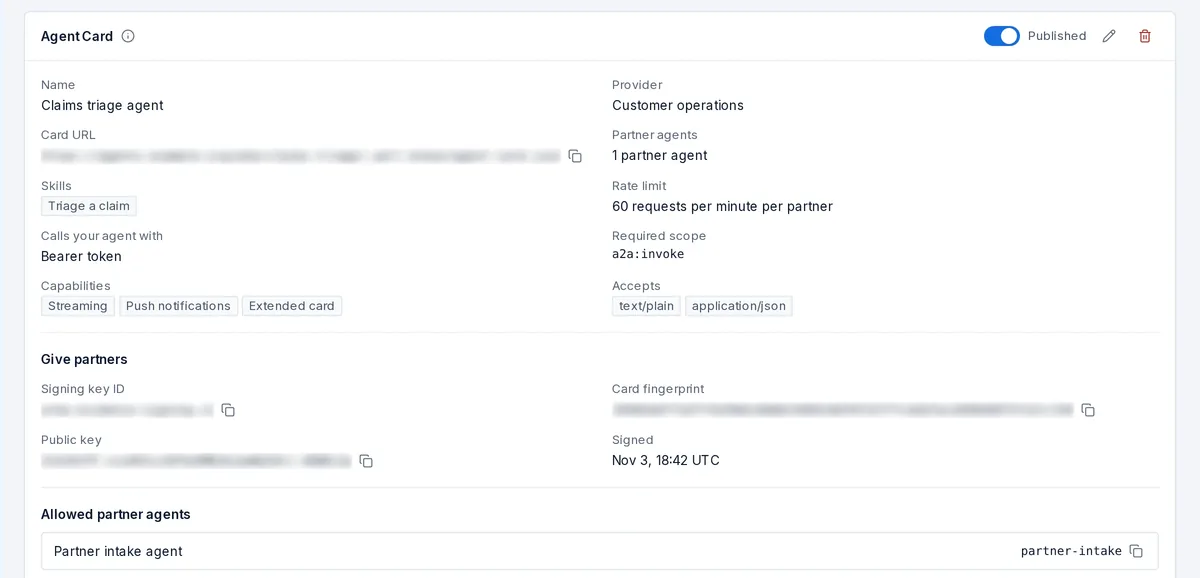
A published A2A Agent Card in the Skyfix console: the agent name, provider, one partner agent, a rate limit of 60 requests per minute per partner, the skill it offers, the required scope, bearer-token authentication, accepted content types, the signing key ID, public key and card fingerprint, and the allowed partner agent.A published A2A Agent Card in the Skyfix console: the agent name, provider, one partner agent, a rate limit of 60 requests per minute per partner, the skill it offers, the required scope, bearer-token authentication, accepted content types, the signing key ID, public key and card fingerprint, and the allowed partner agent.
A2A Agent Card. A published Agent Card with skills, partner scope, rate limit and signing details for inbound A2A tasks.Illustrative synthetic data

01

Agent-to-agent traffic needs the same controls

A partner's agent that sends your agent a task is a caller like any other: it must be identified, limited and recorded, and the task it sends may carry an injection or data you must not accept. Your own agent handing work to an external agent is an outbound call that must respect budgets and data policy. Skyfix treats both as governed requests on the Agent2Agent protocol.

02

Publish a signed Agent Card

Each workspace environment can publish one inbound agent, off by default. The control plane renders its Agent Card from operator fields: the skills it offers, the required scope, the accepted content types and the capabilities such as streaming and push notifications. The card is signed under your installation's own keys, and the signing key ID and card fingerprint are shown so a partner can verify what it received.

03

Governed inbound tasks

  • Partner allowlist
  • Rate limit per partner

Inbound tasks arrive at the gateway, which is the front door; an internal agent you register does the work. A partner must be on the allowlist, present a bearer token with the required scope, and stay within its rate limit, which is set per partner. Authentication, authorization and limit decisions are recorded in the ledger before the internal agent sees the task.

04

Outbound federation

Handoffs to registered external agents leave through the same gateway. The task passes identity, policy, the AI Firewall, the budget check and the ledger exactly like a model call, so data that must not leave your boundary is redacted or blocked before it does, and the cost of the handoff is attributed to the workflow that made it.

05

Operating the inbound agent

  • Published toggle

The inbound agent is off until someone publishes it, and unpublishing withdraws the card at once. Its skills, scope, accepted content types and partner list are edited in the console as a governed change, so a new partner or a new skill is an audited action with an owner. The card's signing key and fingerprint are shown next to the card, and a rotation produces a new fingerprint that partners can verify against the previous one.

06

Bindings

Inbound and outbound tasks use JSON-RPC, gRPC or HTTP+JSON, the three standard bindings of A2A 1.0. The implementation is tested against the official conformance suite.

07

Evidence for every task

Every inbound and outbound task lands in the hash-chained ledger with the partner or external agent, the scope, the policy result, the firewall outcome, the budget status and the trace ID, grouped with the model and tool calls it caused. An auditor can follow one partner task through everything it triggered.

FAQ

Questions this page answers

What is an A2A gateway?

The front door for Agent2Agent protocol traffic. It publishes your agent's signed card, authenticates partner agents, checks what they may ask, applies limits and records every task before an internal agent sees it, and governs the tasks your agents send out.

How is an agent gateway different from an MCP gateway?

An MCP gateway governs an agent calling tools; an A2A gateway governs agents calling agents, inbound from partners and outbound to external agents. Skyfix runs both in the same gateway with the same policy, inspection, budgets and ledger.

Which A2A bindings are supported?

JSON-RPC, gRPC and HTTP+JSON, the three standard bindings of A2A 1.0, tested against the official conformance suite.

How are partner agents authorized?

A partner must be on the allowlist, present a bearer token carrying the required scope and stay within its per-partner rate limit. Each decision is recorded in the ledger.

Do agent tasks draw from the same budgets as model calls?

Yes. Inbound and outbound tasks are governed requests that draw from the same workspace, team, workflow and end-user budgets and appear in the same cost views.