Skip to content
AI Gateway guide

LLM routing inside the limits policy allows

LLM routing chooses which model answers a request. In Skyfix that choice is made only after policy, budgets and guardrails have narrowed the options: the router ranks eligible models by task, cost, latency and region, fails over inside the same limits, and records why it chose what it chose.

  • Hard gates first
  • Garuda task router
  • Routing evidence

01

Hard gates first

  • Order

A routing layer that can pick a model policy forbids is a policy bypass. Skyfix evaluates the gates before any preference: the regions and providers the workspace allows and denies, the data-residency rule for the request's data class, the budgets that apply to the key, team, workflow and end user, and the guardrail outcome from the AI Firewall. Only the models that survive every gate are candidates. A request with no surviving candidate is refused with the gate that stopped it, and that refusal is in the ledger.

02

The Garuda task router

  • Signed heads

When an application asks for 'auto', Garuda classifies the request by task type and ranks the eligible models for it, preferring a lower-cost model where the task allows and a stronger one where it does not. Router heads are signed artifacts that your installation verifies and re-signs before loading, like detection packs; when no head is present, the gateway falls back to baseline routing by the alias mapping and fallback order.

Garuda never widens the candidate set. It chooses among what policy already allows, and its choice is recorded with the task class and the reason.

03

Failover, circuit breakers and caching

Each provider has a connection test, health checks and a circuit breaker. When the preferred provider fails or its breaker is open, the load-balancing strategy moves to the next provider in the fallback order, and only to one that passes the same gates. Response and semantic caches, administered per installation, can answer a request without a provider call where policy allows; a cache hit is a routing outcome with its own ledger entry and its own cost line.

  • A breaker opens on repeated failures and closes after a successful probe.
  • Fallback never crosses a region, residency or allowlist rule.
  • Cache hits are recorded as hits, with the savings shown separately in FinOps.

04

Routing evidence

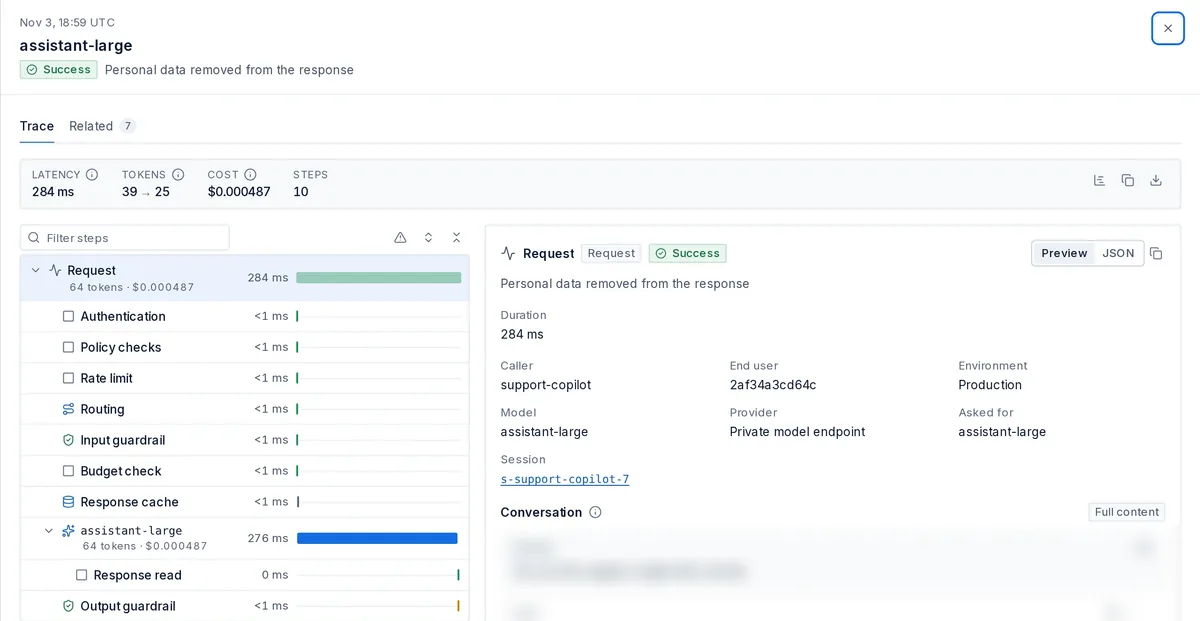
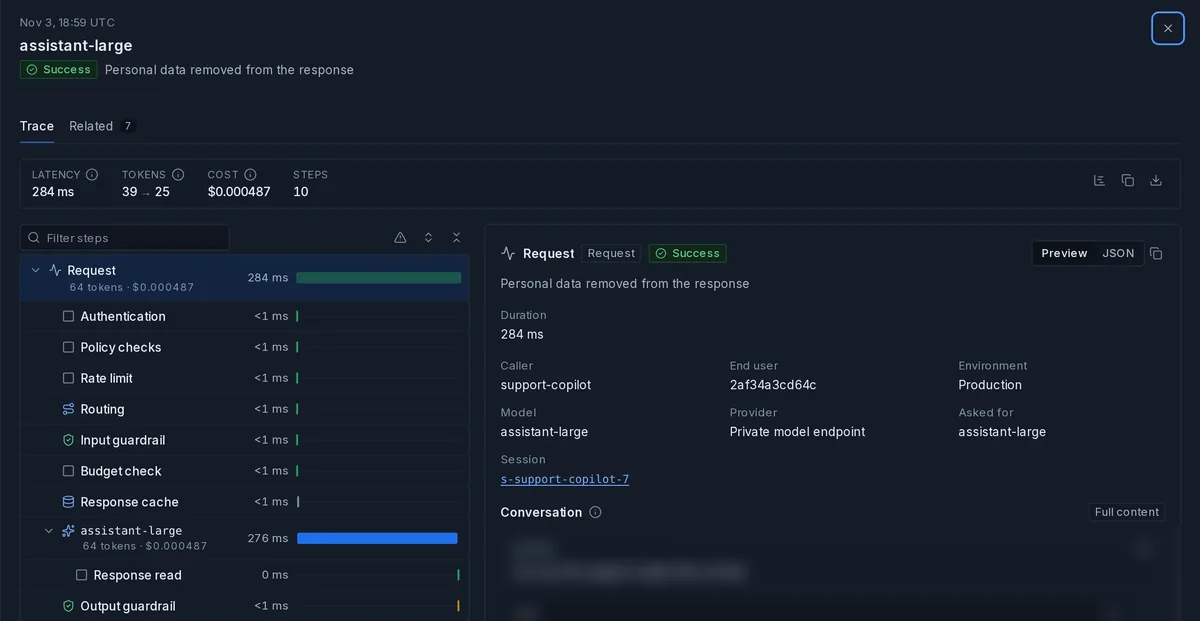
Every decision records the alias asked for, the task class, the route reason, the models skipped and why, the provider used, the fallback reason if any, the cache outcome and the trace ID. The request trace shows the routing step on the waterfall next to policy, guardrails and the budget check, so an engineer can answer 'why this model?' from one screen and an auditor can verify it from the signed ledger.

A request trace in the Skyfix console: a timing waterfall with authentication, policy checks, rate limit, routing, input guardrail, budget check, response cache, the model call and output guardrail, next to the request details (caller, end user, environment, model, provider and session) and a conversation panel whose content is hidden.A request trace in the Skyfix console: a timing waterfall with authentication, policy checks, rate limit, routing, input guardrail, budget check, response cache, the model call and output guardrail, next to the request details (caller, end user, environment, model, provider and session) and a conversation panel whose content is hidden.
One request, traced. The routing step sits on the same waterfall as policy, guardrails and the budget check, with the route reason recorded.Illustrative synthetic data

05

Evaluating routing changes

Before changing an alias mapping or enabling a router head, compare the candidates in an experiment: variants run over a saved dataset through the governed gateway, scored by versioned evaluators, with results paired by item and a regression badge. Because the experiment traffic is governed, it respects the same budgets and data controls as production and leaves signed evidence.

FAQ

Questions this page answers

What is LLM routing?

The decision of which model and provider answer a request. In Skyfix it happens after policy, budgets and guardrails have narrowed the candidates, by alias mapping or by Garuda's task classification, with failover and caching inside the same limits.

Can routing ever pick a model that policy denies?

No. Region and provider lists, data residency, budgets and guardrails are evaluated first and remove ineligible models. The router, including fallback, chooses only among what remains.

How does fallback work?

The load-balancing strategy moves to the next provider in the configured order when the preferred one fails or its circuit breaker is open. The fallback must pass the same gates, and the ledger records the providers skipped and the reason.

What does the router record for each decision?

The alias, task class, route reason, models skipped, provider used, fallback reason, cache outcome and trace ID, visible on the request trace and in the signed ledger.

Does routing require application changes?

No. Applications call an alias, or 'auto', through the industry-standard chat-completions API. Routing rules, fallback order and router heads are managed by platform teams in the console.